 801 988 6800

What Is Voice Phishing (Vishing)? How It Works and How Businesses Can Prevent It
Key Takeaways
- Human-Centric Target: Voice phishing (vishing) bypasses technical defenses by using phone calls to manipulate human trust, authority, and urgency.
- High-Risk Targets: Attackers frequently impersonate IT help desks, executives, and banks to trick employees into sharing multi-factor authentication (MFA) codes or approving wire transfers.
- The Golden Rule: Never trust a request solely because it comes over the phone; always verify identity through an independent, trusted channel.
- Layered Defense: Organizations can protect themselves by combining employee training (like the CALM framework), strict verification procedures, and automated robocall screening tools.

Voice phishing—commonly known as vishing—has become one of the fastest-growing forms of social engineering targeting businesses. Unlike email phishing, which relies on malicious links or attachments, vishing uses the telephone to exploit something much harder to defend against: human trust.
A convincing caller claiming to be your bank, a software vendor, your company’s IT department, or even a senior executive can pressure employees into bypassing security procedures. As caller ID spoofing, AI-generated voices, and publicly available business information grow more sophisticated, these voice-based attacks are increasingly difficult to recognize.
According to the Cybersecurity and Infrastructure Security Agency (CISA) and the National Institute of Standards and Technology (NIST), social engineering remains one of the most effective methods attackers use because it targets people rather than technology. Organizations must pair technical controls with employee awareness and strict identity verification procedures.
Whether you manage IT, cybersecurity, operations, finance, or customer service, understanding how vishing works is essential for protecting your organization.
What Is Voice Phishing (Vishing)?
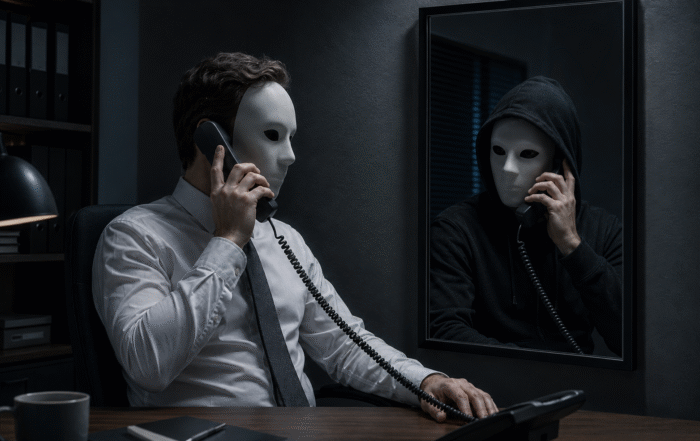
Voice phishing, or vishing, is a social engineering attack where criminals use telephone calls or voice messages to trick people into revealing sensitive information or executing unauthorized actions. Instead of exploiting software vulnerabilities, vishing exploits psychology—specifically trust, urgency, and authority.
Attackers typically impersonate trusted entities, such as:
- Your company’s IT help desk
- Senior executives or department managers
- Banks and financial institutions
- Government or regulatory agencies
- Software vendors and cloud service providers
- Healthcare, utility, or delivery companies
The ultimate objective of these calls is rarely conversation; attackers want the victim to:
- Reveal usernames, passwords, or multi-factor authentication (MFA) codes
- Approve fraudulent wire transfers or payments
- Alter payroll or vendor banking details
- Install remote access software
- Disclose confidential customer or company data
Unlike traditional robocalls that play a prerecorded message, modern vishing attacks often leverage AI-assisted conversational technology that responds naturally to questions. Combined with caller ID spoofing and open-source intelligence gathered from company websites or social media, these scams can appear remarkably legitimate.
Vishing vs. Phishing
Although they share the same objective, phishing and vishing use different communication channels.
| Phishing | Vishing |
|---|---|
| Uses email, text messages, or fake websites | Uses phone calls or voice messages |
| Often relies on malicious links or attachments | Relies on conversation, persuasion, and urgency |
| Gives recipients time to inspect a message | Pressures victims to make immediate decisions during a live call |
| Technical email security tools can filter many attacks. | Success depends heavily on employee awareness, verification procedures, and secure voice security practices. |
The common thread is that both attacks seek to manipulate people rather than break through technical defenses. That’s why organizations increasingly view vishing as part of their overall cybersecurity strategy—not simply a telecommunications issue.
How Does a Vishing Attack Work?
Most successful vishing attacks succeed because criminals carefully engineer a scenario that forces people to make quick decisions under pressure.
Although every attack is different, most follow a five-step operational pattern.
1. Reconnaissance
Before placing a call, attackers harvest publicly available data to build a convincing profile of their target. They often scour:
- Company websites and press releases
- LinkedIn profiles and social media accounts
- Public business directories and vendor pages
Gathering employee names, job titles, and internal systems allows attackers to sound informed and credible from the very first sentence.
2. Caller ID Spoofing
To ensure someone picks up the phone, attackers manipulate caller ID systems to display a familiar or trusted number. The call may falsely appear to originate from:
- Your company’s main office or a local area code
- Your primary bank or financial institution
- A known software vendor or technology provider
- This immediate familiarity lowers a victim’s natural guard before the conversation even begins.
3. Establishing Credibility
Once the phone is answered, the attacker works to cement their legitimacy. Instead of demanding sensitive information right away, they drop inside details—such as a recent company project, an IT ticket, or a manager’s name—making the interaction feel routine and expected.
4. Creating Pressure
Almost every vishing attack manufactures a crisis to force impulsive action. The caller might claim that:
- Your corporate account has been compromised.
- A critical system outage requires immediate troubleshooting.
- An executive urgently needs a financial transaction processed.
By manufacturing a high-stakes emergency, the attacker discourages careful thinking and prompts the victim to bypass normal verification protocols.
5. Executing the Request
Only after the trap is set does the attacker make their move. Common demands include reading an MFA code aloud, approving a wire transfer, resetting credentials, or installing remote support software.
Because the conversation is interactive, attackers can instantly answer questions, adapt to hesitation, and counter objections in real time—making this human-to-human channel far more persuasive than a standard email phishing link.
Why the Phone Remains So Effective
Unlike email, phone conversations are interactive.
Attackers can answer questions, adapt their story, reassure hesitant employees, and respond to objections in real time. This ability to hold a natural conversation makes vishing one of the most persuasive forms of social engineering.
Understanding how these attacks unfold helps employees recognize suspicious behavior before a simple phone call becomes a costly security incident.

Common Vishing Tactics and Real-World Scenarios
Attackers rarely invent completely new scams. Instead, they rely on proven playbooks that exploit standard business routines. Reviewing how these attacks look in practice helps employees spot the warning signs before a call turns into a security incident.
1. IT Help Desk Impersonation
The Tactic: A caller claims to be from internal IT or a trusted software provider, warning that unusual login activity has been detected.
The Scenario: An employee receives a call stating their account is compromised. The caller asks them to “verify their identity” by reading back a multi-factor authentication (MFA) code just sent to their phone. The employee complies, unknowingly handing the attacker the final key needed to log in.
How to Prevent It: IT staff will never ask you to read back an MFA code over the phone. If you receive this call, hang up and contact your internal help desk through a verified company channel.
2. Executive Impersonation (CEO Fraud)
The Tactic: A criminal impersonates a senior executive, creating intense pressure to process a confidential financial transaction immediately.
The Scenario: A finance team member gets a call from “the CEO,” who claims to be locked in a high-stakes meeting and needs an urgent, highly confidential wire transfer completed before the end of the business day. Because the caller knows the company’s executive names and terminology, it sounds entirely legitimate.
How to Prevent It: Financial transactions must always follow strict, established approval workflows. No executive order should ever bypass standard verification protocols.
3. Vendor or Supplier Impersonation
The Tactic: Attackers pretend to represent a long-standing supplier or third-party service provider to redirect corporate funds.
The Scenario: The accounts payable team receives a call from a familiar vendor claiming their banking details have changed due to an internal system update. Without checking further, the team updates the payment instructions, sending the next round of invoices straight to the attacker’s account.
How to Prevent It: Any sudden change to banking or payment details must be independently confirmed using a pre-established, trusted contact phone number on file—never via the new contact info provided on the incoming call.
4. Technology Support Scams
The Tactic: Callers pose as external tech support or managed service providers, claiming malware or critical vulnerabilities have been detected on corporate hardware.
The Scenario: An employee is told their workstation requires urgent maintenance. The caller persuades them to download remote access software or share login credentials to “fix” the problem.
How to Prevent It: Never grant remote access or provide credentials to an unsolicited caller claiming to represent a tech vendor.
5. Financial Institution and Government Scams
The Tactic: Criminals impersonate banks, credit card companies, or regulatory agencies, claiming corporate accounts are frozen or under investigation.
The Scenario: The caller states that a corporate credit card has suspicious charges and demands immediate confirmation of full account details or a temporary fund transfer to a “secure holding account.”
How to Prevent It: Legitimate financial institutions and government regulators have formal verification channels and will never pressure you into immediate financial compliance over an unsolicited call.
The Common Pattern Behind Every Attack
While these scenarios target different departments, they all rely on the exact same psychological levers:
- Authority: “I’m calling from IT, your bank, or the CEO’s office.”
- Urgency: “This must be resolved immediately.”
- Trust: “Here’s specific information only a legitimate insider would know.”
Once employees learn to recognize this pattern, they stop asking, “Does this caller sound legitimate?” and start asking the only question that matters: “Have I independently verified this person’s identity before acting?”

Warning Signs Employees Should Never Ignore
Most vishing attacks contain warning signs that become obvious in hindsight. The challenge is recognizing them during a live conversation, when pressure and urgency can cloud judgment.
Employees should pause and verify the caller’s identity whenever they notice one or more of the following red flags.
1. The Caller Creates Urgency
The caller insists that immediate action is required.
Common phrases include:
- “This can’t wait.”
- “Your account will be locked.”
- “We need this done in the next five minutes.”
- “The CEO needs this completed immediately.”
Creating urgency is one of the oldest and most effective social engineering techniques because it discourages careful thinking.
Rather than forcing employees to determine whether every unfamiliar caller is legitimate, intelligent call screening helps reduce the volume of suspicious calls they encounter in the first place.
2. The Caller Requests Sensitive Information
Legitimate organizations have established procedures for handling confidential information.
Employees should be cautious if a caller asks them to disclose:
- Passwords
- Multi-factor authentication (MFA) codes
- Banking information
- Customer records
- Employee records
- Administrative credentials
As a general rule, authentication codes are meant to verify you—not the caller.
3. The Caller Discourages Verification
A common tactic is to discourage employees from following normal procedures.
Examples include:
- “Don’t call anyone else.”
- “This is confidential.”
- “You’ll delay an important project.”
- “I’m authorized to approve this.”
Legitimate callers should never object to reasonable verification steps.
4. Something Doesn’t Feel Right
Sometimes the strongest warning sign is intuition.
Perhaps the caller:
- Sounds unusually aggressive.
- Avoids answering straightforward questions.
- Changes their story.
- Becomes frustrated when asked to verify their identity.
- Pressures the employee to ignore company policy.
Employees should feel empowered to pause the conversation, end the call if necessary, and verify the request through trusted channels.
Remember the CALM Framework
When a phone call seems suspicious, employees can use the CALM Framework to slow the conversation down and make informed decisions.
| Step | Action |
|---|---|
| C — Confirm | Verify the caller’s identity using a trusted phone number, company directory, or official contact method. |
| A — Assess | Consider whether the request is unusual, urgent, or inconsistent with normal business procedures. |
| L — Limit | Do not share sensitive information or approve requests until identity has been independently verified. |
| M — Monitor & Report | Report suspicious calls to your IT or security team so the organization can monitor patterns and warn other employees. |
The CALM Framework is intentionally simple because effective security habits are easier to remember and apply under pressure. A brief pause to confirm a caller’s identity can prevent hours—or even months—of incident response and recovery
How Businesses Can Prevent Vishing
There is no single solution that can eliminate every vishing attack. As with other forms of social engineering, the strongest defense combines informed employees, well-defined business processes, and technologies that reduce opportunities for attackers.
Organizations that successfully defend against vishing typically approach the problem from three perspectives: People, Process, and Technology.
People: Build a Security-Aware Culture
Employees are often the first line of defense against voice-based attacks.
Regular cybersecurity awareness training should help employees recognize common vishing tactics, including impersonation, caller ID spoofing, urgency, and requests for confidential information.
Training should also reinforce a simple principle:
It’s always acceptable to pause, verify, and call back using a trusted number.
Organizations can further strengthen awareness by conducting periodic vishing simulations, tabletop exercises, or role-playing scenarios that help employees practice responding to suspicious calls in a controlled environment.
Process: Standardize Verification Procedures
Even well-trained employees need clear policies to follow.
Organizations should establish standardized verification procedures for requests involving:
- Wire transfers
- Banking changes
- Payroll updates
- Password resets
- Multi-factor authentication (MFA)
- Customer or employee records
- Administrative account access
Employees should never feel pressured to bypass established procedures simply because a caller claims to be an executive, a trusted vendor, or a government official.
A simple call-back policy—using a verified phone number from an internal directory or official website—can prevent many vishing attacks from succeeding.
Technology: Reduce Risk Before the Phone Rings
Technology cannot replace employee judgment, but it can significantly reduce the number of suspicious calls employees receive.
Organizations should consider implementing:
- Intelligent robocall detection and blocking
- Caller authentication technologies, such as STIR/SHAKEN
- Secure enterprise communications platforms
- Centralized call monitoring and reporting
- Security logging and incident response procedures
Reducing the volume of fraudulent calls allows employees to focus on legitimate conversations while giving IT and security teams greater visibility into potential threats.
A Layered Defense Is Essential
The most resilient organizations don’t rely on a single technology or policy.
Instead, they combine:
- Security-aware employees
- Consistent verification procedures
- Modern communications infrastructure
- Intelligent robocall protection
- Ongoing monitoring and continuous improvement
Together, these layers make it significantly more difficult for attackers to exploit trust over the phone.
Callegra Robocall Blocker for Business
Callegra Robocall Blocker for Business helps strengthen one important layer of an organization’s voice security strategy by helping identify and reduce potentially fraudulent or unwanted calls before they reach employees.
Rather than replacing employee awareness training or established verification procedures, enterprise robocall protection complements them by reducing unnecessary interruptions and providing greater visibility into suspicious calling activity.
When combined with secure communications solutions such as Callegra.UC, organizations can better protect employees while maintaining productive, reliable communications with customers, partners, and vendors.
Because effective voice security isn’t built on a single product—it’s built on multiple layers working together.

Frequently Asked Questions
What is the difference between vishing and phishing?
Both are forms of social engineering designed to trick people into revealing sensitive information or performing actions that benefit an attacker. The primary difference is the communication channel.
- Phishing typically uses email, text messages, or fake websites.
- Vishing uses phone calls or voice messages to persuade victims through conversation.
While phishing often relies on malicious links or attachments, vishing depends on trust, authority, and urgency during a live conversation.
Can caller ID be trusted?
Not always. Attackers can use caller ID spoofing to make a phone call appear as though it comes from a trusted organization, local phone number, or even someone within your own company. For this reason, caller ID should be treated as a convenience feature—not a method of identity verification.
Can AI imitate someone’s voice?
Yes. Advances in artificial intelligence have made it possible to generate highly realistic synthetic voices using relatively small audio samples.
Although traditional vishing attacks remain more common, AI-generated voices are making impersonation attempts increasingly convincing. Organizations should verify sensitive requests using trusted communication channels rather than relying solely on a caller’s voice.
What should I do if I think I’ve received a vishing call?
If you suspect a call is fraudulent:
- End the conversation politely.
- Do not provide passwords, MFA codes, or confidential information.
- Verify the request using a trusted phone number or official contact method.
- Report the incident to your IT or security team.
- If financial information may have been compromised, notify the appropriate financial institution immediately.
Prompt reporting allows organizations to warn other employees and respond before additional attacks occur.
Are businesses more likely to be targeted than individuals?
Businesses are attractive targets because they manage financial transactions, sensitive information, and critical systems.
A successful attack against a single organization can produce far greater financial rewards than thousands of unsuccessful calls to consumers. As a result, attackers often tailor vishing campaigns to specific departments such as finance, HR, IT, customer service, and executive leadership.
Can businesses completely prevent vishing?
No. Because vishing relies on human interaction and constantly evolving social engineering tactics, no organization can eliminate the risk entirely.
However, businesses can significantly reduce their exposure by combining employee awareness, strong verification procedures, intelligent call screening, secure communications, and ongoing security monitoring as part of a layered defense strategy.
Final Thoughts
Voice phishing succeeds not because of technical wizardry, but because attackers exploit human trust, authority, and pressure. However, organizations can significantly mitigate this risk by combining vigilant employees, strict verification protocols, and modern voice security tools.
The golden rule remains simple: never trust a request solely because it came over a phone call. Always verify identity through a separate, trusted channel before sharing sensitive data or approving transactions.
Start building your voice security strategy. Schedule your free consultation today with a Callegra expert.