
 801 988 6800

Caller ID Spoofing Explained: How Scammers Fake Phone Numbers
Key Takeaways
- Caller ID spoofing makes a call appear to come from a different number than its true source.
- A familiar caller ID does not prove that the caller is legitimate.
- Attackers use spoofing to increase answer rates and make vishing, fraud, and impersonation attacks more convincing.
- STIR/SHAKEN can improve caller authentication, but it does not eliminate fraudulent calls.
- Businesses should use a layered defense combining call screening, employee awareness, independent verification, and monitoring.
- Employees should never approve sensitive requests based solely on caller ID.
When your phone rings and the screen shows your bank’s number, your company’s main line, or a familiar local area code, it is natural to assume the caller is who they claim to be.
But caller ID is not proof of identity.
Caller ID spoofing is a technique that allows a caller to manipulate the information displayed on a recipient’s phone, making a call appear to come from a different phone number or caller identity. Scammers use it to make unwanted calls appear more legitimate, increase answer rates, and create the trust they need to carry out fraud or social engineering attacks.
For businesses, the risk goes beyond nuisance calls. A spoofed number can make a fraudulent call appear to come from a trusted customer, supplier, bank, government agency, executive, or even another employee.
That makes caller ID spoofing an important component of modern voice-based attacks—including robocalls, vishing, business impersonation, and financial fraud.
Table of Contents
- What Is Caller ID Spoofing?
- How Does Caller ID Spoofing Work?
- Why Do Scammers Spoof Phone Numbers?
- Why Is Caller ID Spoofing a Serious Risk for Businesses?
- How Can Businesses Detect and Prevent Caller ID Spoofing?
- What Should an Employee Do If They Receive a Spoofed Call?
- A Simple Rule for Employees
- Frequently Asked Questions
- Final Thoughts
What Is Caller ID Spoofing?
Caller ID spoofing is the deliberate manipulation of caller identification information so that a phone call appears to originate from a different number or identity than its true source.
The technology behind spoofing is not inherently malicious. There are legitimate reasons why a business or organization may want a particular number displayed when placing calls. For example, a company with multiple offices may configure its outbound calls to display a central customer-service number rather than an individual employee’s direct number.
The problem occurs when criminals use similar capabilities to impersonate a trusted caller.
A scammer might make a call appear to come from:
- A local phone number
- A customer’s number
- A company’s main office
- A bank or financial institution
- A government agency
- A healthcare provider
- A senior executive
- An employee’s internal extension
The displayed number may look completely legitimate while having little or no relationship to the actual caller.
Why Do Scammers Spoof Phone Numbers?
The simplest reason is trust. People are more likely to answer a call when they recognize the number or see a familiar area code. Once the call is answered, a convincing caller can use that initial trust to continue the interaction. Spoofing can therefore serve as the first step in a much larger attack.
For example:
Caller ID Spoofing → Robocall → Live Scammer → Vishing → Fraud or Data Theft
An attacker may spoof a trusted number, use an automated message to create urgency, connect the recipient to a live operator, and then attempt to persuade the victim to provide credentials, reveal sensitive information, approve a transaction, or perform another harmful action.
This is why caller ID spoofing should not be viewed only as a telecommunications nuisance. In a business environment, it can become an important part of a broader social engineering strategy.
Can Caller ID Spoofing Be Stopped?
Caller authentication technologies have made it harder for some attackers to spoof numbers successfully. In the United States, the STIR/SHAKEN framework allows participating voice service providers to authenticate caller ID information and provide receiving carriers with information about whether the caller is authorized to use a particular number.
However, authentication is not the same as determining whether a call is trustworthy. A call can involve an authenticated number and still be unwanted, deceptive, or part of a social engineering campaign. STIR/SHAKEN also does not apply identically across every network and calling environment.
For businesses, that means caller authentication should be viewed as one layer of protection—not a complete voice security strategy.
Organizations should combine it with intelligent call screening, employee awareness, verification procedures, and other security controls to reduce the risk of fraudulent calls reaching employees.
The Most Important Rule
Never treat caller ID as proof of identity. If a caller requests sensitive information, financial action, credentials, or an exception to normal procedures, employees should independently verify the request using a trusted communication channel—even when the number displayed on the phone appears legitimate.
That simple habit can turn caller ID from a source of misplaced confidence into what it should be: a useful piece of information, but never the final word on who is calling.
How Does Caller ID Spoofing Work?
Caller ID spoofing works by manipulating the information associated with an outbound call so that the receiving phone displays a number chosen by the caller rather than necessarily showing the caller’s actual originating number.
The underlying telecommunications infrastructure is complex, but the basic concept is straightforward:
The Caller ID Spoofing Process
This is what happens at each stage of the process:
1. The Attacker Places the Call: The attacker initiates a phone call using a voice service, calling platform, internet-based calling service, or compromised telecommunications infrastructure.
2. The Caller ID Information Is Manipulated: The attacker supplies or modifies the caller identification data so that the recipient sees a different number (such as a local area code or a trusted organization’s line) rather than the actual originating number.
3. The Call Travels Through Voice Networks: The call passes through one or more interconnected carrier networks, moving toward its destination without a universal mechanism to instantly prove the originating caller is authorized to use the displayed number.
4. The Receiving Carrier Processes the Call: The receiving carrier applies analytics and technologies—such as STIR/SHAKEN, reputation data, and calling pattern analysis—to evaluate the incoming call, though authentication alone does not guarantee safety.
5. The Recipient Sees the Spoofed Number: The phone displays the manipulated number, creating the critical psychological moment where the recipient assumes the call is familiar or trustworthy.
6. The Attacker Uses That Trust: Once the recipient answers, the attacker leverages the established credibility to execute a social engineering, vishing, or impersonation attack.
Why Spoofing a Local Number Works
One particularly common tactic is known as neighbor spoofing. Instead of displaying a completely unfamiliar number, the attacker uses a number with a similar area code or prefix to the recipient’s own phone number.
For example, if an employee’s business number begins with a particular local area code, a spoofed call may display a number from that same area. The goal is simple: make the call look familiar enough that the recipient is more likely to answer. Once answered, the attacker can move from technical deception to psychological manipulation.
Spoofing Is About More Than Fooling the Phone
It’s important to understand that caller ID spoofing does not necessarily mean the attacker has gained control of the number being displayed. The attacker may simply be manipulating the information presented to the recipient. That distinction matters because businesses should not assume that a suspicious call is harmless simply because the displayed number belongs to a legitimate company.
A scammer can impersonate the number without compromising the legitimate organization behind it. Likewise, receiving a suspicious call that appears to come from your own company’s number does not automatically mean your phone system has been hacked. The displayed caller ID is one data point—not proof of the caller’s identity.
How STIR/SHAKEN Changes the Equation
The telecommunications industry has introduced STIR/SHAKEN to make caller ID authentication more reliable on participating networks.
At a high level, the framework allows originating providers to digitally attest to information about the caller and the number being presented. Receiving providers can then use that information when determining how to handle the call.
This makes certain forms of spoofing more difficult and gives carriers additional information for call analytics and mitigation. But it does not eliminate every fraudulent call. Attackers can still use legitimate numbers, operate through environments where authentication is limited, or shift their tactics from simply spoofing a number to manipulating the person who answers the phone.
That’s why organizations should think of caller authentication as one component of a broader layered voice security strategy rather than a standalone solution.
Why Do Scammers Spoof Phone Numbers?
Caller ID spoofing is valuable to scammers because trust increases the likelihood that someone will answer a call and believe what they hear.
An unfamiliar number may be ignored. A call that appears to come from a bank, a local business, a company executive, or a familiar area code is much more likely to receive attention.
For attackers, that small increase in credibility can make large-scale fraud campaigns significantly more effective.
1. To Make People More Likely to Answer
Many people routinely ignore calls from unfamiliar numbers. Scammers can work around this by displaying a number that looks familiar or local. This tactic, sometimes called neighbor spoofing, makes an incoming call appear to come from a nearby number.
For businesses, the same principle applies. An employee may be more likely to answer a call that appears to originate from a local customer, supplier, or business number than one from an unfamiliar international number.
The objective is simple:
Get the person to answer first.
Once the conversation begins, the attacker has an opportunity to establish trust.
2. To Impersonate Trusted Organizations
Scammers may spoof numbers associated with organizations that people already recognize and trust.
Depending on the target, an attacker may pretend to represent:
- A bank
- A government agency
- A healthcare provider
- A technology company
- A delivery service
- A utility company
- A business supplier
The displayed number becomes part of the impersonation. If an employee sees a familiar company name or number on the screen, they may unconsciously treat the call as legitimate before verifying who is actually speaking.
3. To Impersonate Executives and Employees
Businesses can be especially vulnerable when attackers spoof internal or familiar numbers. Imagine an employee receives a call that appears to come from the company’s main office or a senior executive. The caller says:
“I’m in a meeting and need you to handle something urgently.”
The employee may be less suspicious because the phone appears to confirm the caller’s identity. This is particularly dangerous for finance, HR, IT, executive assistants, and other departments that routinely handle sensitive information or high-value transactions.
4. To Support Vishing Attacks
Caller ID spoofing is often not the final objective. Instead, it can be the first stage of a vishing attack. The attacker uses a spoofed number to establish credibility, then uses conversation and social engineering to persuade the victim to take an action.
For example:
Spoofed bank number → “Suspicious transaction” → Urgency → Request for verification code → Account compromise
Or:
Spoofed executive number → “Urgent payment” → Confidentiality request → Employee bypasses verification → Financial loss
The spoofed caller ID doesn’t perform the fraud by itself. It helps make the subsequent deception more believable.
5. To Increase the Effectiveness of Robocall Campaigns
Scammers and illegal telemarketers may place enormous volumes of automated calls. If those calls always display the same number, recipients and carriers can more easily identify and block them.
By rotating or spoofing numbers, attackers can make their campaigns more difficult to recognize and disrupt.
This is one reason why simply blocking individual phone numbers is often insufficient for businesses. A sophisticated campaign may use many different numbers while following the same underlying calling pattern.
6. To Exploit Familiarity
Perhaps the most important reason spoofing works is psychological. Humans use shortcuts to make decisions. When a phone displays a familiar number, we naturally treat that information as evidence that the caller is familiar. But the number displayed on the screen answers only one question:
“What number is being presented to me?”
It does not necessarily answer:
“Who is actually calling me?”
That distinction is critical for businesses. A legitimate-looking caller ID can be combined with a convincing voice, publicly available company information, and an urgent request to create a highly persuasive social engineering attack.
The Business Security Implication
Caller ID spoofing turns an ordinary phone call into a potential trust exploit.
The technology itself may seem simple, but its effectiveness comes from what happens afterward. Once an attacker has convinced an employee that a call is legitimate, traditional security procedures may be challenged by pressure, urgency, and authority.
That’s why organizations should not train employees simply to “watch out for suspicious numbers.”
Instead, employees should learn to recognize suspicious requests and behaviors, regardless of what appears on the caller ID screen.
If a caller requests sensitive information, financial action, credentials, or an exception to normal procedures, the appropriate response is the same whether the call appears to come from an unknown number or the CEO’s phone:
Pause. Verify independently. Then act.

Why Is Caller ID Spoofing a Serious Risk for Businesses?
Caller ID spoofing is more than a nuisance for organizations. When attackers use a trusted phone number to gain credibility, a spoofed call can become the starting point for financial fraud, credential theft, data exposure, or other security incidents.
The risk is particularly significant because businesses often rely on phone calls to conduct legitimate, time-sensitive transactions. Employees regularly communicate with customers, vendors, banks, executives, IT providers, and government agencies. Attackers can exploit those normal business relationships to make fraudulent requests appear routine.
Financial Fraud
One of the most immediate risks is fraudulent payment activity.
An attacker may impersonate an executive, supplier, customer, or financial institution and request:
- A wire transfer
- A change to banking information
- An urgent invoice payment
- A refund
- A purchase of gift cards
- Access to a financial account
When the caller ID appears to match a trusted contact, an employee may be less likely to question the request.
A single successful transaction can result in substantial financial losses, particularly when attackers target employees who have authority over payments or financial accounts.
Credential and Account Theft
Spoofed calls can also be used to obtain credentials.
An attacker may impersonate IT support and claim that an employee’s account has been compromised. They might ask the employee to:
- Confirm a username
- Reset a password
- Provide a verification code
- Approve a login request
- Install remote-access software
The attacker doesn’t necessarily need to break through the organization’s technical defenses. They may simply persuade an authorized employee to help them bypass those defenses.
Sensitive Information Exposure
Businesses routinely handle information that attackers can monetize or use in subsequent attacks.
A spoofed caller may attempt to obtain:
- Customer information
- Employee records
- Internal contact information
- Financial details
- Account numbers
- Operational information
- Confidential business data
Even information that appears harmless in isolation can help an attacker construct a more convincing follow-up attack.
Employee and Executive Impersonation
Attackers can use spoofing to impersonate people within the organization.
A call appearing to originate from an executive or department may carry an implied level of authority. Employees may feel uncomfortable questioning a senior person’s request, particularly when the caller creates urgency or claims the matter is confidential.
This creates a dangerous combination:
Familiar identity + authority + urgency = increased likelihood of compliance
Organizations should therefore ensure that verification procedures apply to everyone, including executives and senior leadership.
Customer Trust and Reputation
Businesses can also be affected when scammers impersonate the organization itself.
Customers may receive fraudulent calls that appear to come from a legitimate business and then associate the experience with the company’s brand.
For example, a criminal could spoof a company’s customer service number and attempt to convince customers to provide payment information or account credentials.
Even though the business did not make the call, customers may still perceive the organization as responsible.
This creates a reputational challenge: businesses need to protect not only their employees, but also the trust customers place in their communications.
Operational Disruption
High-volume spoofed calls can overwhelm employees and phone systems.
A flood of unwanted calls can:
- Interrupt customer service teams
- Consume employee time
- Overload phone lines
- Distract employees from legitimate customers
- Increase call-handling costs
- Make important calls harder to identify
For organizations that depend heavily on telephone communications, the cumulative productivity loss can become significant even when individual calls do not result in fraud.
The Bigger Problem: Spoofing Makes Other Attacks More Convincing
Perhaps the greatest risk is that caller ID spoofing rarely exists in isolation.
It can be combined with:
- Robocalling
- Vishing
- AI-generated voices
- Publicly available employee information
- Stolen credentials
- Business email compromise
- Social engineering
This creates a multi-stage attack in which the spoofed phone number is only the first layer of deception.
An attacker might begin with a spoofed call, gather information from an employee, follow up by email, impersonate a manager, and eventually persuade someone to approve a fraudulent transaction.
The result is why organizations should treat voice communications as part of their broader cybersecurity environment.
Caller ID Is a Signal, Not an Identity Verification System
The central lesson for businesses is simple:
A legitimate-looking phone number does not guarantee a legitimate caller.
Employees should evaluate the request itself and independently verify sensitive actions before proceeding.
Technology can help reduce the number of suspicious calls that reach employees, but organizations should also establish procedures that prevent a single spoofed caller ID from becoming enough evidence to authorize a sensitive action.
In other words, the objective isn’t simply to teach employees to recognize fake numbers. It’s to build a system in which a fake number cannot easily become a successful attack.
How Can Businesses Detect and Prevent Caller ID Spoofing?
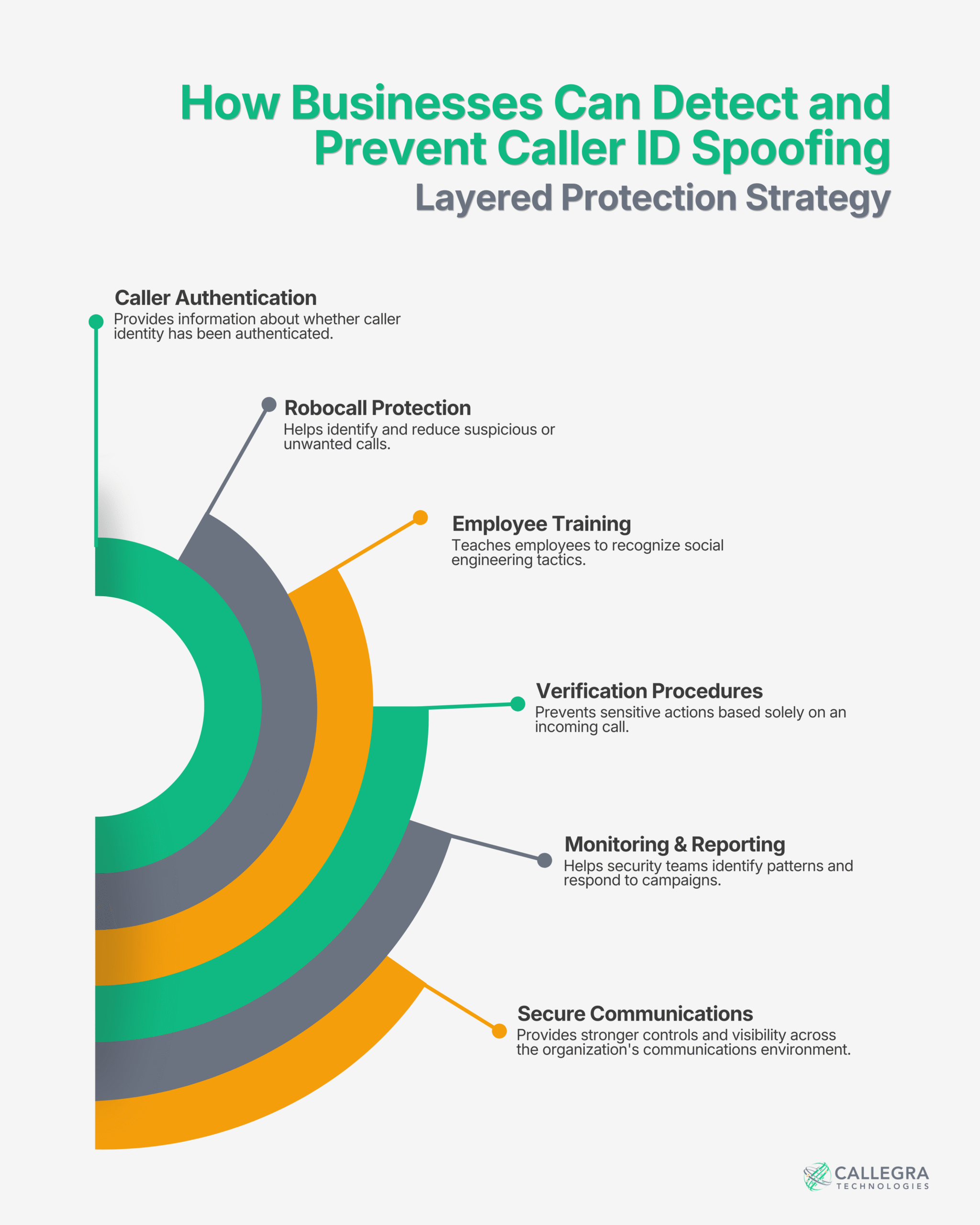
Businesses cannot rely on caller ID alone to determine whether an incoming call is legitimate. A stronger approach combines call authentication, intelligent screening, employee verification procedures, and ongoing monitoring.
The goal is not to identify every spoofed call manually. It is to create multiple layers of protection so that a deceptive caller has fewer opportunities to reach an employee, establish trust, or convince someone to take an unsafe action.
1. Use Caller Authentication Technologies
One important layer is caller authentication.
In the United States, STIR/SHAKEN provides a framework for participating voice providers to authenticate caller ID information and communicate whether the originating provider can attest to the caller’s use of the number.
This can make certain forms of caller ID spoofing more difficult and gives receiving providers additional information when evaluating calls.
However, authentication should not be treated as a guarantee that a call is safe.
A call may still be unwanted, deceptive, or part of a social engineering attack even when caller authentication information is available. Organizations should therefore combine authentication with other detection and security measures.
2. Deploy Intelligent Robocall Protection
Businesses receive far too many calls to expect employees to manually evaluate every unfamiliar number.
Intelligent robocall protection can help reduce that burden by analyzing incoming calls using multiple signals and identifying potentially unwanted or suspicious activity.
Depending on the solution, these signals may include:
- Caller reputation
- Authentication information
- Known fraudulent numbers
- Calling behavior and patterns
- Call volume
- Other indicators associated with suspicious activity
The advantage is not simply blocking calls. It is helping organizations reduce the number of potentially malicious calls that reach employees in the first place.
Callegra Robocall Blocker for Business is designed to provide this additional layer of protection for businesses, helping organizations reduce unwanted and potentially fraudulent calls while allowing legitimate communications to continue.
3. Establish Independent Verification Procedures
Technology should never be the only defense. Businesses should establish clear procedures for verifying sensitive requests made over the phone. For example, employees should independently verify requests involving:
- Wire transfers
- Banking changes
- Payroll information
- Password resets
- MFA codes
- Confidential records
- Administrative access
Verification should use a trusted channel that is independent of the incoming call. If a caller claims to be a supplier and requests a change to payment information, employees should contact the supplier using a phone number already stored in the company’s records—not a number provided by the caller.
Likewise, if someone claiming to be an executive requests an urgent financial transaction, the employee should use the organization’s established verification process before acting.
4. Train Employees Not to Trust Caller ID
Security awareness training should address an important misconception:
Caller ID can be useful information, but it is not proof of identity.
Employees should understand that scammers can make calls appear to originate from:
- Local numbers
- Company numbers
- Executive numbers
- Banks
- Government agencies
- Customers
- Vendors
Training should focus less on memorizing suspicious phone numbers and more on recognizing suspicious requests and behaviors. Employees should be particularly cautious when a caller combines:
Authority + urgency + secrecy + a request for sensitive action
That combination should trigger independent verification.
5. Create a Simple Call-Back Policy
A formal call-back policy can turn a potentially subjective decision into a repeatable security control. For example:
If a caller requests sensitive information or an unusual action, end the call and contact the person or organization using a trusted number.
The trusted number might come from:
- An internal company directory
- An existing customer record
- A previously established vendor contact
- An official company website
- A verified financial institution contact
The key is that the employee—not the caller—controls the source of the verification information.
6. Monitor and Report Suspicious Calls
Employees should have an easy way to report suspicious calls. Security and IT teams can use those reports to identify patterns that individual employees might not notice.
For example, several employees may report calls that:
- Claim to come from the same organization
- Use similar scripts
- Request the same type of information
- Arrive within a short period
- Appear to originate from different numbers
Looking at these incidents collectively can reveal an organized campaign.
Organizations should also document successful and attempted attacks so that lessons can be incorporated into future awareness training and security procedures.
7. Protect the Organization’s Own Numbers
Caller ID spoofing creates an unusual challenge: your organization can be impersonated even when your own systems have not been compromised. A scammer may make a fraudulent call appear to come from your company’s customer service number, executive office, or another legitimate business line.
Businesses should therefore have a plan for responding when customers or employees report suspicious calls that appear to originate from the organization. That may include:
- Documenting reported incidents
- Alerting customers when appropriate
- Coordinating with telecommunications providers
- Reviewing authentication and call-management controls
- Monitoring for recurring patterns
- Providing employees with clear guidance on how to respond
Protecting your brand from telephone impersonation is increasingly part of protecting your overall digital identity.
8. Treat Voice as Part of the Security Perimeter
Email, endpoints, cloud applications, and networks have long been treated as security concerns. Voice communications should be treated the same way. A business phone call can now be used to:
- Obtain credentials
- Initiate financial fraud
- Gather intelligence
- Impersonate employees
- Bypass security procedures
- Prepare for a larger cyberattack
That means voice security should not sit entirely outside the organization’s cybersecurity strategy.
No single layer is perfect. Together, however, they create a much stronger defense than relying on caller ID—or employee intuition—alone.
Callegra Robocall Blocker for Business can serve as one component of this layered strategy by helping organizations identify and reduce unwanted or potentially fraudulent calls before they become an employee’s problem.
For organizations also looking to modernize their broader communications environment, Callegra.UC provides a unified communications platform designed to bring voice and other business communications into a more manageable environment.
The objective is not to promise that technology can make every phone call safe.
It is to make suspicious calls harder to reach employees, harder to trust, and harder to turn into successful attacks.
What Should an Employee Do If They Receive a Spoofed Call?
Employees generally cannot determine with certainty whether a caller ID has been spoofed simply by looking at the phone screen. The safest approach is therefore not to become an expert at identifying fake numbers, but to know what to do when a call involves an unusual or sensitive request.
Use these steps when something doesn’t seem right.
1. Don’t Assume the Caller Is Legitimate
A familiar number can create a false sense of security. If the caller claims to represent your bank, IT department, executive team, customer, or supplier, remember that the displayed number does not independently verify their identity. Treat caller ID as information—not authentication.
2. Slow the Conversation Down
Attackers often create urgency because they know people make different decisions when they feel pressured. If someone insists that you act immediately, pause.
You can simply say:
“I need to verify this request before I proceed.”
A legitimate caller should be able to tolerate a reasonable verification process.
3. Don’t Share Sensitive Information
Never provide passwords, MFA codes, financial information, confidential records, or other sensitive data simply because someone asks over the phone.
Be especially cautious if the caller asks you to:
- Read a verification code aloud
- Reset your password
- Approve a login
- Install software
- Transfer money
- Change payment information
- Reveal customer or employee information
4. End the Call if Necessary
Employees sometimes remain on suspicious calls because they worry that hanging up will appear rude or unprofessional. Security should take priority over politeness.
If the conversation becomes suspicious, end the call. You do not need to prove that the caller is a scammer before disconnecting.
5. Verify Through a Trusted Channel
If the request could be legitimate, verify it independently. For example:
- Call the executive back using a number from the company directory.
- Contact the supplier using the number already stored in your records.
- Call your bank using the official number on its website or account documentation.
- Contact IT through the organization’s established support channel.
Never use a phone number supplied by the suspicious caller as your verification method. Otherwise, you may simply be reconnecting with the same attacker.
6. Report the Call
Suspicious calls should be reported even when no information was disclosed. Reporting helps security and IT teams determine whether multiple employees are experiencing the same attack.
Useful information may include:
- Date and time of the call
- Number displayed on caller ID
- What the caller claimed to represent
- What information or action they requested
- Whether any information was disclosed
- Any callback number or other details provided
A single suspicious call may not appear significant. Several similar reports can reveal an organized campaign.
7. If You Shared Information, Act Quickly
Mistakes happen. An employee who realizes they have disclosed credentials, financial information, or an MFA code should report the incident immediately rather than waiting to see what happens.
Depending on the situation, the organization’s response team may need to:
- Reset compromised credentials
- Revoke active sessions
- Contact financial institutions
- Review account activity
- Preserve evidence
- Notify affected stakeholders
- Investigate related activity
Early reporting can significantly reduce the potential impact of an incident.
A Simple Rule for Employees
When an unexpected caller requests something sensitive, remember: Don’t trust the number. Don’t rush the decision. Verify independently.
The objective isn’t to teach every employee how telecommunications networks work. It’s to create a simple behavior that works even when the attacker is using a convincing number, a familiar name, or a realistic voice. When employees know they are allowed to pause and verify—even when the caller appears to be a senior executive or trusted organization—they become a much stronger layer of defense.

Frequently Asked Questions
Can you tell if a phone number has been spoofed?
Not reliably from caller ID alone. A spoofed call can display a legitimate phone number, local number, or familiar business number, making it difficult for the recipient to determine the call’s true origin simply by looking at the screen.
Caller authentication technologies and carrier-level analytics can provide additional information, but employees should not rely on the displayed number as proof of identity. For sensitive requests, independent verification is the safest approach.
Can caller ID spoofing be traced?
In some cases, telecommunications providers and law enforcement agencies can investigate the origin of a spoofed call using network records and other technical information. However, tracing can be complicated when calls pass through multiple providers, internet-based calling services, international networks, or other intermediary systems.
Businesses should therefore report suspicious calls rather than attempting to investigate the source themselves. Preserving information such as the displayed number, date, time, and nature of the call can help security teams and service providers investigate patterns.
Is caller ID spoofing illegal?
Caller ID spoofing is not inherently illegal because there are legitimate reasons for organizations to modify the number displayed on outbound calls.
However, using spoofed caller ID information for fraudulent, deceptive, or harmful purposes can violate laws and regulations. In the United States, the Truth in Caller ID Act prohibits certain forms of caller ID spoofing when used with the intent to defraud, cause harm, or wrongfully obtain anything of value.
Laws vary by country, so organizations should consult applicable telecommunications and fraud regulations in the jurisdictions where they operate.
Does blocking a spoofed number stop the scammer?
Usually, blocking one spoofed number is not enough. Attackers can rotate through large numbers of phone numbers or generate calls that appear to originate from different numbers. Blocking individual numbers may therefore provide limited protection against sophisticated campaigns. Businesses generally benefit more from layered controls such as intelligent call screening, caller authentication, reputation analysis, employee awareness, and verification procedures.
Why do scammers use local numbers?
Scammers often use local or familiar-looking numbers because recipients are more likely to answer them. This tactic is sometimes called neighbor spoofing. The displayed number may use the same area code or a similar prefix as the recipient’s own number, creating the impression that the call is coming from a nearby person or business. The objective is to increase the likelihood that the call will be answered.
Can scammers spoof a company’s phone number?
Yes. A fraudulent caller may make an incoming call appear to originate from a legitimate business number, including a company’s main line or customer service number. This does not necessarily mean that the company’s telephone system has been compromised. The attacker may simply be manipulating the caller ID information associated with the outgoing call. Businesses should therefore have procedures for responding when customers or employees report calls that appear to originate from the organization but were not actually made by it.
Can scammers spoof an internal employee’s number?
Depending on the telecommunications environment, attackers may be able to make a call appear to originate from a number associated with an employee or department. This can be particularly dangerous because an internal-looking call may receive more trust than an unfamiliar external number. Organizations should establish verification procedures for sensitive requests that apply regardless of whether the call appears to come from inside or outside the company.
Does STIR/SHAKEN prevent caller ID spoofing?
STIR/SHAKEN helps participating voice providers authenticate caller ID information and makes certain types of spoofing more difficult. It is an important part of the telecommunications industry’s effort to improve caller identity authentication. However, it does not eliminate every fraudulent or unwanted call.
Authentication can help establish whether a caller is authorized to use a particular number, but it does not determine whether the caller’s intentions are legitimate. Businesses should therefore combine caller authentication with intelligent call screening, employee awareness, and independent verification procedures.
What is the difference between caller ID spoofing and vishing?
Caller ID spoofing is a technique used to manipulate the phone number or identity displayed to the recipient. Vishing, or voice phishing, is a social engineering attack in which a caller attempts to trick someone into revealing information or taking an action that benefits the attacker.
The two can be used together. For example, an attacker might spoof a bank’s phone number and then use a vishing script to convince an employee to disclose an authentication code.
How should businesses protect employees from spoofed calls?
Businesses should use a layered approach that combines technology and employee procedures.
Key measures include:
- Caller authentication technologies such as STIR/SHAKEN
- Intelligent robocall and call-screening solutions
- Employee security awareness training
- Independent verification procedures
- Clear policies for financial and sensitive requests
- Easy reporting mechanisms for suspicious calls
- Monitoring of recurring call patterns
The goal is not simply to identify every spoofed number. It is to prevent a spoofed caller ID from becoming enough evidence for an employee to trust a caller or approve a sensitive request.
Final Thoughts
Caller ID spoofing turns a familiar phone number into a potential tool for deception, allowing attackers to make fraudulent calls appear trustworthy. Businesses can reduce the risk by combining caller authentication, intelligent call screening, employee awareness, and independent verification procedures. The most important rule is simple: never treat caller ID as proof of identity when a call involves sensitive information or an unusual request.
Caller ID spoofing is only one part of the broader voice threat landscape. Callegra Robocall Blocker helps businesses reduce unwanted and potentially fraudulent calls before they reach employees, adding another layer to a comprehensive voice security strategy.
Strengthen your organization’s voice security. Talk to an expert to learn how Callegra Robocall Blocker for Business can help protect your organization’s communications.
Recent Blogs